In an era where health and wellness have taken centre stage, the role of nutrition in shaping healthier societies has never been more critical. From combating lifestyle diseases to promoting holistic well-being, nutrition professionals are at the forefront of this global movement.
As for Yong Zi Xuan who is pursuing her Bachelor of Science in Nutrition (Hons), her reason to study the programme is on a personal level. “I wanted to equip myself with proven facts and knowledge about nutrition so that I can take better care of my parents’ nutrition intakes, especially in their old age. In this age of information overload, it is difficult to be sure how accurate the information is, what more information on health matters, as the wrong information can have serious effects,” she said.
The degree programme is meticulously crafted to address the evolving demands of the health and wellness industry, blending rigorous academic training with practical, real-world applications. Students delve into the science of human nutrition, exploring topics such as nutrigenetic and nutrigenomic, human anatomy and physiology, sports nutrition, and nutrition policy and food security.
“I like biology, especially studying about human structure. This is why my favourite subject in my degree programme is human anatomy & physiology. What I also appreciate in my degree programme is the many practical exercises and assignments that we need to do. For instance, for the nutrition in lifecycle subject, we conducted a Nutrigreen programme and I presented a talk to a group of secondary school students. It was a great experience for me to be able to share important facts on nutrition with the school students,” Zi Xuan further elaborated.
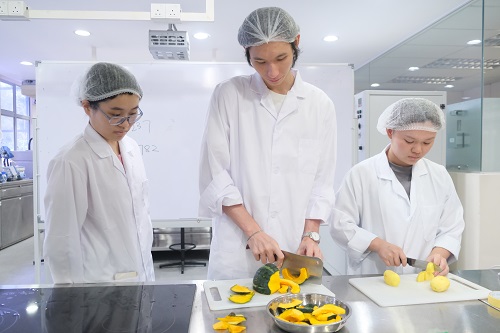
One important aspect of the degree programme is highlighting the importance of public health nutrition, equipping students with the tools to design and implement community-based interventions that address malnutrition, obesity, and other pressing health issues. As described by Xiao Xuan, who is also pursuing TAR UMT’s degree programme in nutrition, who said, “There is a coursework in Nutrition Sociology & Anthropology subject, where we had to set a booth in an event to help participants measure their Bioelectrical Impedance Analysis (BIA). We also had to explain to them how to improve their diet to maintain their health. I found the experience satisfying as I can use my knowledge to help others. I also learnt how to communicate effectively and give advice to others in an efficient way.”
“Looking at the current trend, it would not be surprising that the demand for nutritionists will increase over time. Nutritionists play a crucial role in helping individuals maintain healthy weight, boost their immune system, and reduce the risk of developing certain diseases. Good literacy in nutrition plays an important role, leading to the increasing demand for good and qualified nutritionists. A career in nutrition is ideal for those seeking to promote a balanced lifestyle and improve people’s diets,” explained Assoc Prof Dr Koo Hui Chin, a Registered Dietitian and Programme Leader of the Bachelor of Science (Hons) in Nutrition at TAR UMT.
“This is why TAR UMT students who are studying their degree in nutrition will spend their first year learning about theories. The second and third year will focus more on practical approaches, such as community-based research activities to produce suitable and practical nutritional plans for the communities and learning how to provide professional consultation on nutrition. These are in addition to the customary industrial training.”
“All in all, the programme aims to develop a wide range of skills in students to empower them in providing evidence-based nutritional guidelines and recommendations in nutrition and food-related industries. Other career prospects include community nutritionist, corporate wellness nutritionist, food industry nutritionist and private practice nutritionist. The degree programme also aims to prepare technically competent graduates to venture into entrepreneurship, Dr Koo concluded.