Nurturing a love for learning and instilling positive character traits in early childhood lays the foundation for a child's future. It builds self-confidence during their primary school years and shapes them into more compassionate, optimistic individuals as they grow. Given the importance that children are the future generation, the early childhood degree programme at TAR UMT equips students with a thorough theoretical understanding of young children’s holistic development, focusing on their emotional, social, physical, and cognitive growth, to nurture the next generation of educators.
The Bachelor of Early Childhood Education (Hons) programme emphasises real-world experience as essential for developing skilled educators. Students engage in hands-on training through micro-teachings, observations, and a compulsory 240-hour internship at preschools and childcare centres, where they practise classroom management and lesson planning under industry supervision.
Lee Zhe Chin, a final-year student of the Bachelor of Early Childhood Education (Hons), has completed her practicum and is now working at an international preschool. She shared some of the reasons why she pursued her degree in early childhood education. "From a young age, I’ve always been passionate about nurturing and guiding children during their formative years. Pursuing my degree in early childhood education has been a fulfilling journey, as it allows me to combine my love for teaching with an understanding of how to create meaningful learning experiences for young minds. This programme gave me the knowledge and confidence to make a positive impact, which I am now applying in my role as an educator."
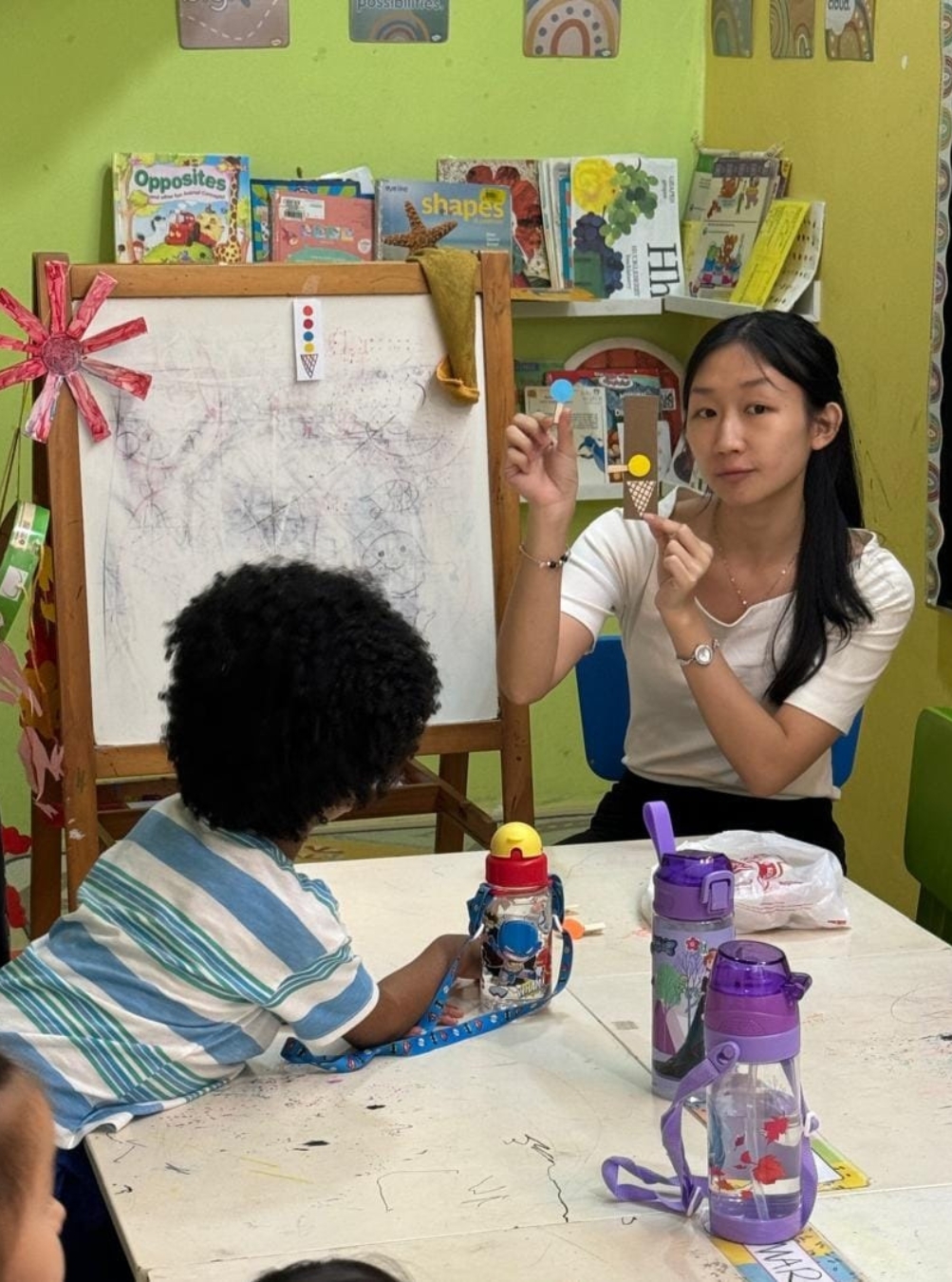
Zhe Chin engaging young learners using creative props during a learning session.
On the programme itself, she shared, "Child Development is a core subject in my degree that has been pivotal in shaping my understanding of how children grow and learn. The subject focuses on the four key components of child development: physical, cognitive, social-emotional, and language development. Through assignments and assessments, I learned to design lessons that cater to these components, ensuring they are both challenging and achievable. For example, understanding social-emotional development enabled me to implement hands-on activities in my classroom. I established a calm-down corner where students can learn to self-soothe and manage their emotions. This space has been in place for several months and has proven to be highly effective for my students. I use this technique to teach them how to resolve emotional challenges independently. Additionally, I consistently remind my students to try solving academic or peer communication issues on their own before seeking assistance from me. I encourage them to believe in themselves and assure them that they are capable of achieving their goals.”
“For practical situations, such as accidents like spilling food or water, I have created a designated area with cloths and tissues. Students can use the cloths to wipe water from their tables and tissues for flavoured liquids or food spills. Instead of focusing solely on teaching or conducting problem-solving activities, I help children develop positive habits for daily life. In my view, a supportive classroom environment is one where children have easy access to tools and resources that empower them to solve problems independently.”
She further shared how understanding the relationship between actions and consequences has been instrumental in shaping a child’s behaviour. “For instance, I had a child who enjoyed squeezing glue excessively, and during one lesson, he squeezed glue into a marker box. To help him understand the consequences of his actions, I emptied the markers onto his table and showed him the sticky mess he had created. I then asked him to clean both the box and the markers, and he no longer repeated this action,” she shared.
She added, “One of the most joyous moments I’ve experienced as an early childhood educator is witnessing my students' growth, both intellectually and socially. For instance, I once had a 4-year-old student who initially didn’t know how to hold a pencil or write. After months of practice, he now writes his name and actively participates in class, which fills me with pride. Another source of joy is seeing the children enjoy the activities I plan. Their happy expressions make all the effort feel worthwhile.”
“Another reward as an early childhood educator is when parents express their gratitude for my efforts. Hearing that their child considers me their favourite teacher or feels happy and safe in my presence is truly heart-warming. These moments remind me why I chose this profession and inspire me to keep giving my best.”