Beetroot is rich in nitrates, antioxidants, and betalains — but its earthy taste and the nutrient loss from conventional heat-drying have long limited its appeal as a commercial ingredient. Associate Professor Ts Dr Tang Pei Ling, Programme Leader and Researcher at the Faculty of Applied Sciences (FOAS) believes this does not have to be the case. Her research project, funded by the Government— Integrated Probiotic Fermentation and Ultrasound Treatment to Improve the Sensory and Antioxidant Properties of Beetroot Powder— is rethinking how beetroot is processed from the ground up.
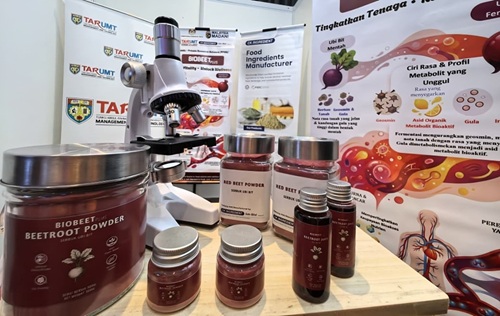
The result of Dr Tang’s research to transform beetroot into a palatable food.
Science Meets the Senses
At its heart, Dr Tang's research is about making a good thing better. Rather than simply drying beetroot the conventional way, her team combines two complementary bioprocessing methods. The first is probiotic fermentation — the introduction of beneficial bacteria that break down sugars into organic acids and other bioactive compounds, a process that naturally reduces the off-flavours consumers find unappealing. The second is ultrasound treatment, which uses sound waves to break down the plant's cellular structure, releasing more nutrients and improving extraction efficiency before the beetroot is converted into powder.
"The key realisation was that no single process could fully solve beetroot's limitations," says Dr Tang. Ultrasound releases more of what is locked inside the plant cells; fermentation transforms what is released. Together, they create what researchers describe as a synergistic effect — the sum greater than its parts.
What the Research Has Achieved
The results have been encouraging. The integrated process delivers enhanced nitrate levels, improved overall sensory acceptance, and a higher product yield compared to standard drying methods. Most importantly, the taste transformation has been tangible. Fermentation reduces the earthy aroma and raw green taste that typically characterise beetroot, replacing them with a mild tangy note that consumers find far more palatable.
The research also addresses a persistent gap in the commercial beetroot powder market: inconsistency. Most products on shelves today lose nutrients during heat processing and offer no declared levels of active compounds such as nitrates and phytochemicals. Dr Tang's method aims to change that, producing a powder with reliably higher and more consistent bioactive content.
There is a sustainability angle too. Because the process can work with second-grade or cosmetically imperfect beets that would otherwise go to waste, it opens up a value chain for produce that the conventional market typically discards — provided quality control markers are implemented to ensure nutrient consistency.
Beyond the Laboratory: An Industry Partnership
What sets this research apart from purely academic inquiry is its direct link to industry. CK Ingredient Sdn. Bhd. is a key collaborator, supporting product development and validation, contributing to scalability, and helping translate the laboratory findings into commercially viable applications. Dr Tang’s research findings in the lab and CK Ingredient Sdn. Bhd.’s commercial expertise led to the development of an innovative functional product — the BioBeet Plus, demonstrating how science and industry can come together to create health-enhancing, value-added food solutions.
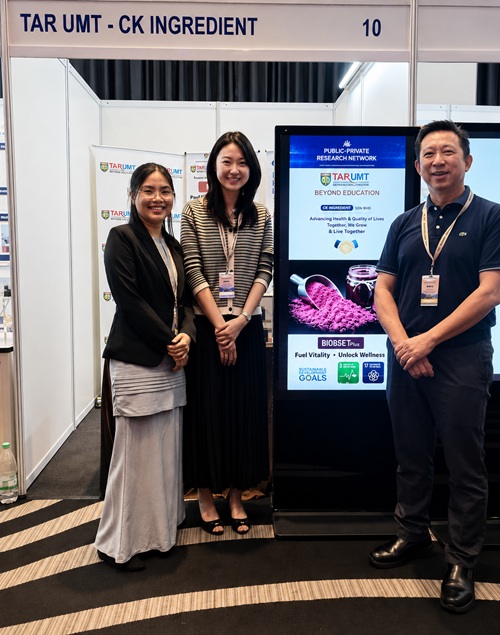
Dr Tang (leftmost) at her exhibition booth showcasing her research findings at the Public-Private Research Network (PPRN) Conference, 7 April 2026, together with Ms Esther Koh, Marketing Manager of CK Ingredient Sdn. Bhd. and Mr Chong Kean Fei, Director of CK Ingredient Sdn. Bhd.
What Comes Next
With the laboratory phase completed, Dr Tang and her team are now focused on scaling up. The next stage involves developing pilot-scale production facilities, evaluating long-term shelf stability, and validating the finished product's health benefits in applied settings. Working alongside CK Ingredient Sdn. Bhd., the team is progressing toward semi-industrial-scale implementation of the process flow within a factory environment.
The team also has its sights set further ahead: exploring whether the same integrated bioprocessing concept can be applied to other plant-based ingredients, potentially opening the door to a broader platform technology for functional food development.